Planning an IoT Project in Nepal: Connectivity, Power and Field Constraints
A practical guide to planning IoT and embedded prototypes in Nepal by thinking early about connectivity, power stability, field conditions, sourcing, and staged validation.
- Nepal
- Connectivity
- Power
- GSM
- LoRa
- Field Testing

- Published
- Updated
- Reading time
- 4 min read
- Author
- Saroj Chaudhary
- Role
- IoT & Embedded Systems Engineer
Planning an IoT project in Nepal usually becomes easier when the prototype is shaped around the real deployment conditions instead of around whichever board or modem is easiest to buy first.
That does not mean Nepal is uniquely difficult. It means the same engineering discipline matters more when site conditions, power quality, maintenance access, and connectivity assumptions can change from one project to the next.
If the main need is a broader regional entry point, start with the Nepal page. If the need is a service-oriented path from idea to prototype, the IoT project development page is the better companion.
Start with the deployment reality, not the component list
Before ordering parts, define the environment the prototype will actually face:
- indoor bench, rooftop, roadside, field, or industrial space
- reliable mains power or intermittent power
- stable Wi-Fi, cellular dependence, or gateway-based telemetry
- regular maintenance access or long unattended periods
- short test runs or multi-week observation
Those answers change the whole architecture. They affect sensor choice, energy storage, enclosure decisions, communication interval, firmware recovery behavior, and even how useful the dashboard will be.
Connectivity is a field decision before it is a radio decision
A development board on a desk can make almost any connectivity path look easy. A field deployment is less forgiving.
In practice, planning usually starts by asking:
- Is there dependable local Wi-Fi where the device will live?
- Does the system need to work away from fixed infrastructure?
- Is a phone or gateway already part of the workflow?
- How expensive is a missed data upload?
- Can the device buffer data locally when the link disappears?
If those answers are still unclear, the connectivity comparison guide is the right next read.
For many Nepal-based monitoring or environmental projects, the challenge is not simply choosing GSM/LTE, LoRa, Wi-Fi, or BLE. The challenge is choosing the path that still behaves honestly once the device leaves the lab and starts dealing with real terrain, coverage variation, and maintenance limits.
Power planning has to happen early
Power is not a detail to solve after the firmware is finished.
When the device may spend time in remote sites, outdoor conditions, or installations that cannot be checked every day, the power model becomes part of the product definition. Questions such as these matter immediately:
- mains powered, battery powered, or solar-assisted
- always-on communication or scheduled telemetry
- high-current modem bursts or lighter periodic messages
- charging access or sealed deployment
- graceful behavior when voltage falls or the system restarts
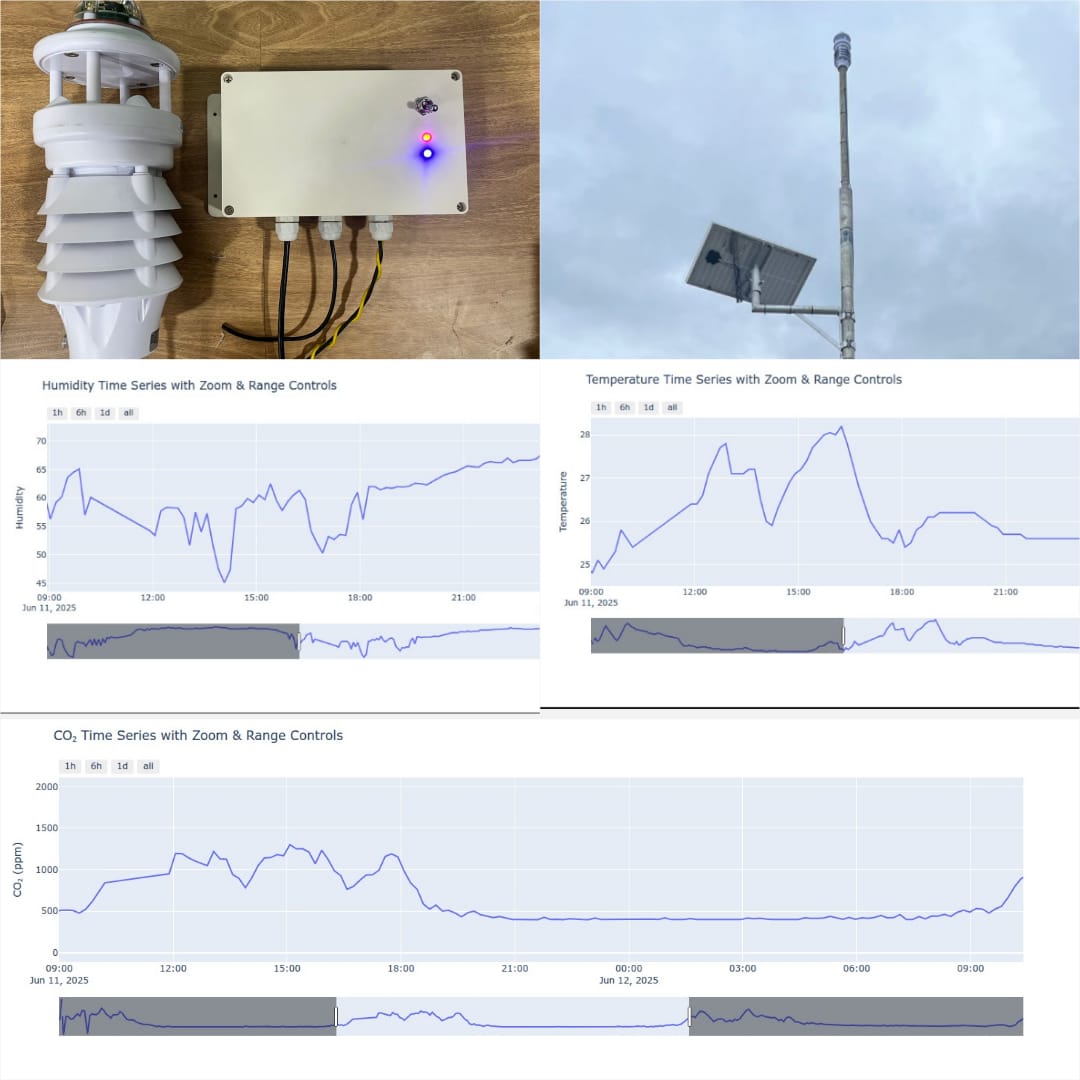
The solar-powered weather and air-quality monitoring station is a useful reminder that sensing and telemetry only make sense when the energy assumptions are credible too.
Field conditions affect the whole prototype
Outdoor and semi-outdoor systems are rarely only about the controller and sensor.
Humidity, dust, wiring exposure, airflow, cable routing, and service access all influence the result. Environmental sensing in particular can fail quietly when the sensor placement, enclosure openings, or maintenance plan are unrealistic.
That is one reason it helps to think in terms of remote monitoring systems instead of isolated hardware modules. The device is only one part of the operating workflow.
Sourcing and iteration should be part of the plan
Early-stage IoT work often gets slowed down not by the first prototype, but by the second one.
It helps to ask:
- what parts are likely to need replacement during iteration
- which modules are just fast prototype tools and which might stay longer
- whether sensor calibration or enclosure changes are likely
- how many revision cycles the project can realistically support
That is especially important when the prototype depends on a sequence of hardware changes rather than a single one-time build.
Students and researchers should reduce scope before they increase parts
This matters a lot in academic and final-year work.
Teams often add more sensors, more radios, or more dashboard features before the first measurement path is even stable. A better pattern is:
- prove one sensing path
- prove one device behavior
- prove one telemetry route
- prove one useful output or dashboard view
If the build is student-led, the dedicated final-year project support page explains the support boundaries more directly.
ESP32 is often a practical start, but it is still only a start
For many connected prototypes, ESP32 development is a practical path because it helps teams validate sensing, communications, and firmware behavior quickly.
But a good Nepal-based prototype still needs more than a familiar controller. It needs realistic connectivity expectations, defensive offline behavior, and a power path that fits the deployment instead of the desk.
A good prototype reduces uncertainty in the real environment
The strongest first prototype is usually the one that answers the hardest real-world question early.
Sometimes that question is connectivity. Sometimes it is energy use, sensor quality, or device reliability after an unexpected restart. The right planning goal is not “make the device do everything.” It is “learn the most important truth before the next round of effort.”
That is the mindset behind both the Nepal page and the broader research and prototyping support work at IoTSolutions: use the prototype to make better engineering decisions before the system grows.