Designing Remote IoT Devices for Unreliable Networks
Practical device-side patterns for keeping remote telemetry useful when coverage drops, power is tight, and physical access is infrequent.
- Telemetry
- GSM
- LoRa
- MQTT
- Power Management
- Firmware
- Published
- Updated
- Reading time
- 4 min read
- Author
- Saroj Chaudhary
- Role
- IoT & Embedded Systems Engineer
Remote IoT devices should be designed with the assumption that the network will fail sometimes. Coverage drops, routers reboot, gateways stall, batteries dip, and field conditions get worse at exactly the wrong time.
If the device only works when the uplink is perfect, it is not really ready for remote monitoring.
Assume the link will fail
One of the healthiest design choices is to stop treating network failure as an exception. In remote systems, it is a normal operating condition.
That changes how you think about firmware. Instead of “read sensor, send packet, done,” the device often needs to become:
- a local data collector
- a queue manager
- a retry scheduler
- a health reporter
- and sometimes a safe local controller
This is why remote monitoring system design is rarely just about modem selection. The firmware behavior matters at least as much as the radio.
Buffer locally with a policy, not with hope
Local buffering is usually the first real reliability feature a remote device needs. But buffering without rules creates its own problems.
You should define:
- what records are stored
- how many records fit locally
- whether raw samples or summaries are saved
- what happens when the buffer is full
- how old data is marked when finally transmitted
For many systems, preserving a useful history is better than preserving every sample. A field device that stores one summary every five minutes for a day is often more useful than one that tries to keep every second-level measurement until the storage fills up.
What should be stored
A good default is to store:
- the measurement payload
- a reliable timestamp
- device health fields such as battery or signal state
- a delivery status flag
That gives the upstream side enough context to decide whether the reading is current, delayed, or part of a catch-up batch.
A simple queue policy example
sample_interval_seconds: 300
transmit_interval_seconds: 1800
max_buffered_records: 288
retry_backoff_seconds:
  - 30
  - 120
  - 600
health_fields:
  - battery_voltage
  - signal_quality
  - buffered_records
  - last_successful_uplink
The exact values depend on the project, but the point is that a deliberate policy is better than ad-hoc retries.
Retry carefully instead of aggressively
A device in poor coverage can easily burn battery by trying too often. That is why retry behavior should usually include backoff.
Instead of retrying every few seconds forever, the device should:
- try once
- wait a short period
- retry a limited number of times
- move back to local storage mode if the link is still bad
This keeps the device useful without turning the modem into a battery drain machine.
Surface device health, not just sensor values
One of the most common weaknesses in early telemetry systems is that the dashboard shows measurements but hides device condition.
For remote work, you often need to know:
- battery voltage or charge state
- signal quality or communication success rate
- how many records are still buffered
- when the last successful uplink happened
- whether the device rebooted recently
That health information belongs in the telemetry model and the dashboard layer, not only in serial logs.
Watchdogs and safe recovery matter
When physical access is infrequent, software recovery becomes part of product behavior. A stuck modem, blocked task, or dead loop should not require someone driving to the site if the device can recover safely on its own.
Watchdogs, restart-safe state handling, and clear boot sequencing are practical tools here. They are not glamorous, but they often matter more than adding one more graph to the interface.
Offline operation is still part of the product
Some systems only measure and report. Others also control pumps, relays, valves, or other physical actions. If the network drops, the control logic still needs a plan.
That may mean:
- continuing with the last safe schedule
- switching to a local fallback rule
- entering a reduced-function mode
- refusing risky actions until connectivity or operator confirmation returns
This is especially important when the device sits inside a larger IoT system architecture, because offline decisions at the edge change what the rest of the stack can assume.
Telemetry interval and power are linked
A device that transmits too often wastes energy. A device that waits too long may hide important events. The right interval depends on what the operator actually needs.
If measurements only need to be reviewed hourly, there is rarely much value in forcing a high-cost uplink every minute. Sometimes the better design is frequent local sampling plus less frequent upstream transmission.
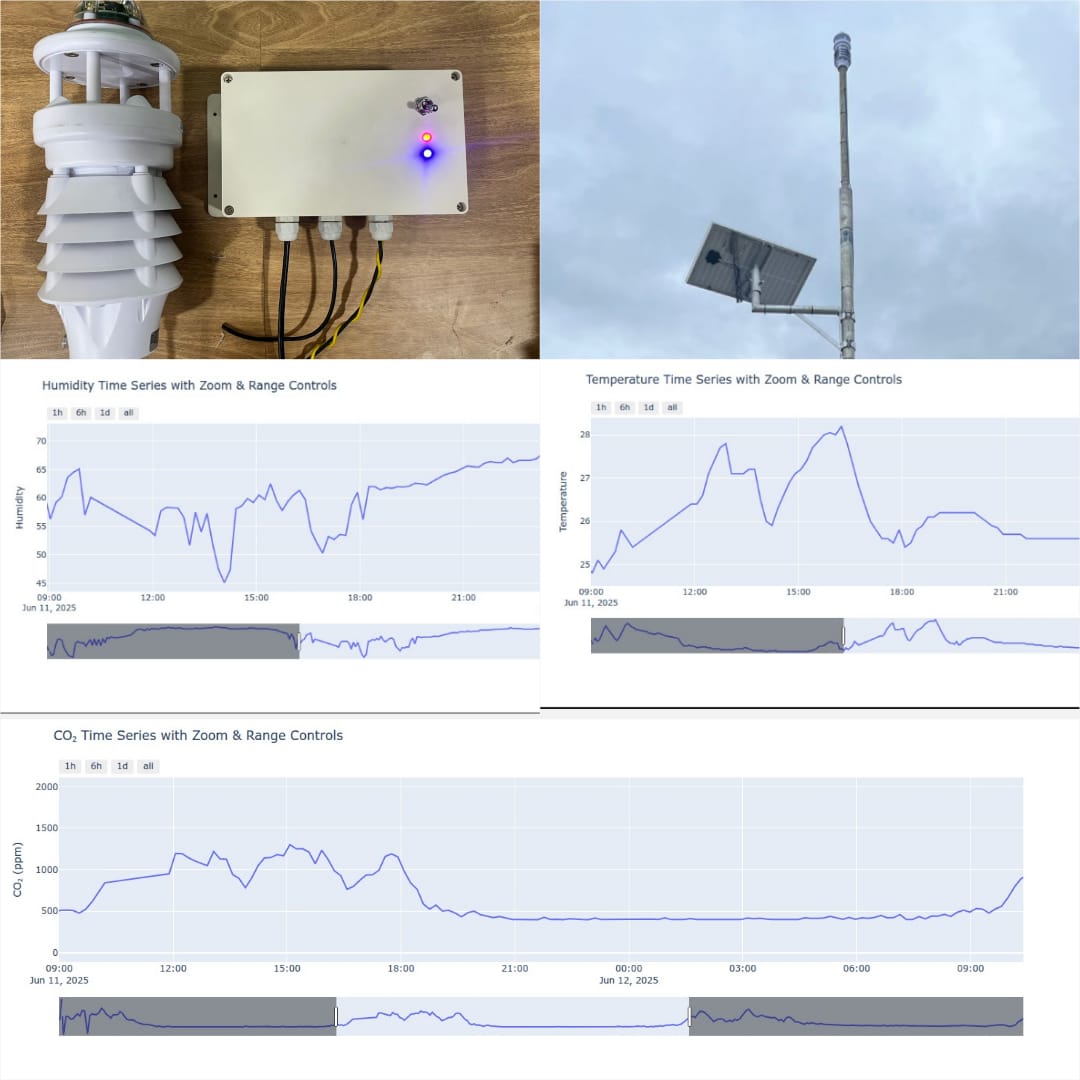
That pattern appears clearly in field-oriented work like the solar-powered weather and air-quality monitoring station, where communication behavior must respect the power budget.
A practical checklist for remote device design
Before calling a remote device architecture “ready,” ask:
- Can it keep working when the network disappears?
- Can it explain its own health remotely?
- Can it store enough useful data locally?
- Can it recover from common firmware or modem failure modes?
- Does the communication rhythm match the power budget?
If the answer to any of those is no, the system is probably still a lab prototype rather than a reliable remote node.